|
Looking into the Workshop...
The processes from cutting a tree trunk into boards right to
the completed quality instrument requires many years of experience and
conscientiousness. To achieve concert quality the best of traditional craft
skills and technical development are brought together. Also more recent concern
for the environment did not pass unnoticed. Already in 1990 after a period of
intensive research into the woodsurface treatment of our instruments, we
changed to organic lacquers and natural oils.
We invite you to accompany
the process of making a Lyre on these two page spreads.
| ...Selecting wood from the
stacks. There are planks of Sycamore and Norway Spruce for framework and backs
and fronts of the instruments. Lime and poplar are used for infill and support.
To achieve the required quality of timber it must dry and be stacked and
re-stacked for about ten years prior to use. |
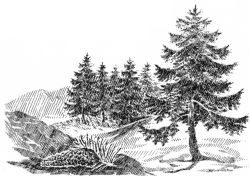
Norway Spruce
with cone..
Rough climatic
conditions and
the
poor soil of the
mountainous regions
ensure firm and
compact growth of
this softwood to
serve the function
of
vibration
transference which
requires elastic qualities
above
all. |
 |
 |
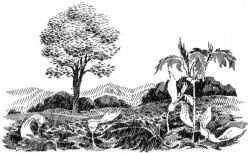 |
Sycamore in
its natural environment.
This firm deciduous
timber is responsible
for the tension
bearing stability
of the
instrument
and offers particular
qualities in the transfer
of
sound vibrations. |
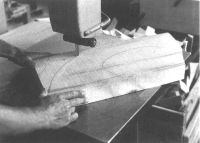
... Cutting the
plank on a
bandsaw |
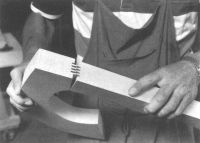 |
Checking the
fit
of the joit before
glueing. Glued under
pressure the frames
then need at least
four weeks to settle
in storage before
further work can be
done on them. |
|
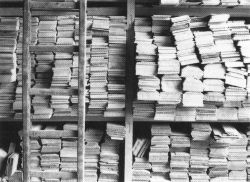 |
. ..A large
assortment
of side and frame pieces
is needed for selecting
different quality grades.
The wood - Sycamore
and Obeche -
must
not become too dry
in storage so that flexibility
is retained for
bending
into the required curves. |

back
|